

Digital recording, processing and decision support for optimized fertilizer management
Data acquisition
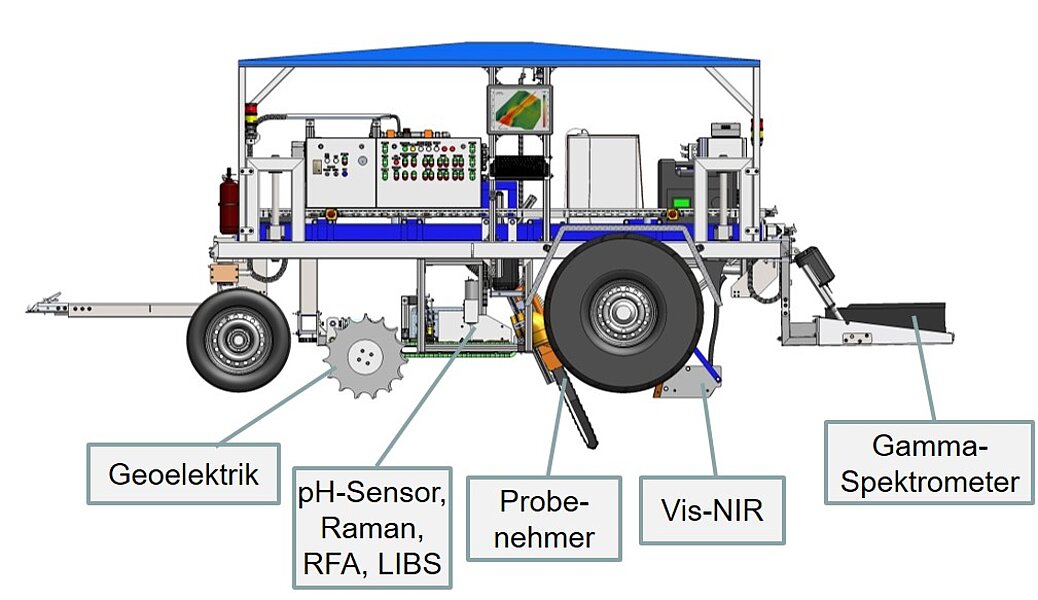
digiMan uses and evaluates digital measurement systems and data sources available in practice to record fertilization-relevant soil and plant parameters. Commercially available mobile soil sensors are used for soil mapping. This will be used to create maps of humus, clay and nutrient content. To record plant growth, freely available satellite data will primarily be used, supplemented where possible by yield mapping using combine harvesters. The aim is to create yield potential maps for fertilization planning and to provide information for operational fertilization.
Data processing
The sensor data requires several processing steps before it can be used to generate information that is useful for fertilization calculations or other management measures. The main steps of data processing are data cleansing, calibration and creation of the parameter map. Data cleansing is necessary because sensor data sometimes contains incorrect or irrelevant data. Since sensor data does not usually record the target variable directly, but rather parameters that correlate with it, calibration is necessary. One example is the green color of the crop, which is measured with optical sensor systems (e.g. satellites) as reflection intensity, but which is not a direct measurement of the grain yield.
Decision support
In the agricultural decision support system, the data is summarized, graphically processed and used for calculations, such as the fertilization requirement, the humus balance or the possible economic profit. digiMan is based on the decision support systems webBESyD and Web-Man, which were developed with the participation of the project partners TUM and HSWT. As a budgeting and recommendation system for fertilization, webBESyD is being tested in Saxony and other federal states (https://www.landwirtschaft.sachsen.de/webbesyd.html). The aim of the digiMan project is to link sensor-based soil and plant measurements with webBESyD.
Active participation of practitioners
The active involvement of farmers and advisors is intended to evaluate existing digital solutions and bring about improvements. The digital methods are to be tested on around 20 farms in Bavaria and Brandenburg, with an equal proportion of conventional and organic farming. Furthermore, four “future farms” are included, which are already part of the “experimental fields” funding program for the digitalization of agriculture. Workshops and field days will serve as an additional point of contact for practitioners. As a project partner, Maschinenring will ensure effective communication with farmers.